
Elite Handling Solution » Tyre Handler Attachments: Essential Equipment for the Tyre Industry
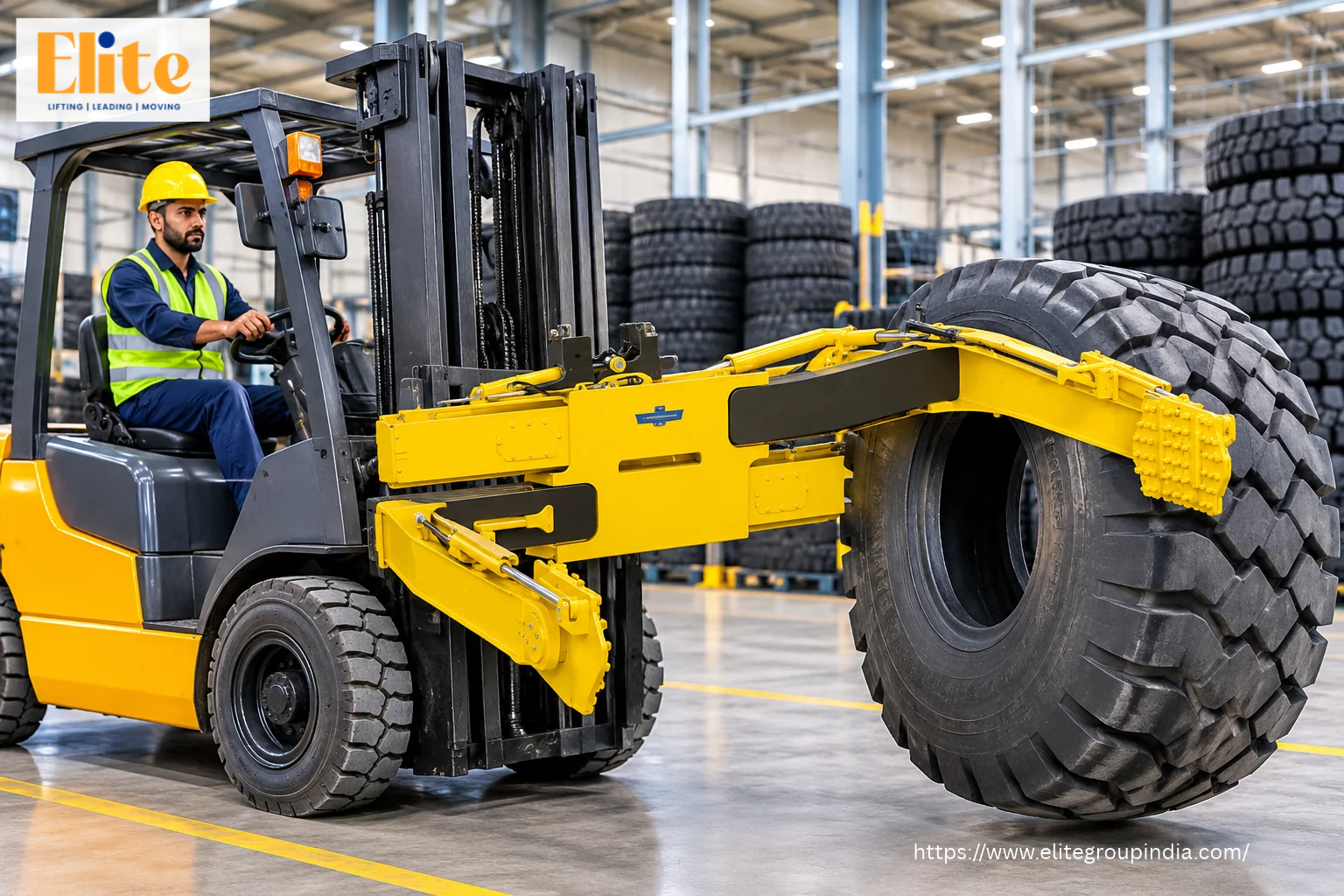
Handling large and heavy tyres is a challenging task across tyre manufacturing facilities, mining operations, construction sites, logistics centres, and industrial warehouses. Commercial vehicle tyres, agricultural tyres, and Off-the-Road (OTR) tyres can be difficult to lift, transport, position, and stack using conventional material-handling equipment.
This is where tyre handler attachments play an important role. Designed to work with compatible material-handling machines, these specialized attachments help operators handle tyres more efficiently while improving control, positioning, and workplace safety.
Whether handling passenger vehicle tyres in a manufacturing facility or oversized mining tyres in heavy equipment operations, the right tyre handling equipment can simplify material movement and reduce dependence on manual handling.
In this guide, we explore how tyre handler attachments work, their key benefits, industrial applications, and the important factors businesses should consider when selecting a suitable tyre handling attachment.
Tyre handler attachments are specialized material-handling devices designed to lift, grip, move, rotate, and position tyres using compatible industrial equipment such as forklifts or other suitable lifting machines.
Unlike conventional forks, which primarily support loads from underneath, tyre handling attachments use application-specific gripping mechanisms to hold tyres securely during movement.
Depending on the design, these attachments may include:
A forklift tyre handler is particularly useful when tyres need to be transported, stacked, or positioned repeatedly within industrial facilities.
The attachment must be selected according to tyre dimensions, weight, equipment compatibility, and the manufacturer’s rated capacity.
Tyre handler attachments operate through a gripping mechanism that holds the tyre securely during lifting and transportation.
In a typical hydraulic tyre handling system, the operator controls the attachment through the host machine’s hydraulic system.
The general operating process includes:
Some advanced configurations also offer rotation or side-shifting capabilities, allowing operators to position tyres more accurately.
The operating principle and available movements vary depending on the attachment design and manufacturer.
Modern tyre handler attachments are designed to address the specific challenges associated with handling different tyre sizes and weights.
Specialized gripping arms help hold tyres during lifting and movement. Properly designed contact surfaces can help reduce unwanted movement and protect the tyre from unnecessary damage.
A suitable tyre handling attachment allows operators to move tyres using compatible lifting equipment rather than relying on manual handling or improvised lifting methods.
Depending on the model, gripping arms may accommodate different tyre diameters and widths. Businesses should verify the approved adjustment range before selecting an attachment.
Rotating and side-shifting features, where available, can help operators position tyres more accurately during storage, loading, and production activities.
Tyres can be heavy, bulky, and difficult to handle manually. Mechanical tyre handling equipment helps reduce the need for direct manual lifting and positioning.
Compatible forklift-mounted attachments can help facilities perform specialized tyre-handling tasks without necessarily purchasing a separate dedicated handling machine.
Tyre handler attachments can contribute to more organized and efficient material-handling operations.
In tyre manufacturing facilities, finished tyres often need to move between production lines, inspection stations, storage areas, and dispatch sections. A suitable attachment helps operators manage these movements with greater control.
In mining and construction environments, large OTR tyres require specialized handling because of their considerable dimensions and weight. Using an appropriately rated attachment can simplify positioning and transportation.
Key operational advantages include:
Actual performance improvements depend on the attachment design, operator training, tyre characteristics, and working conditions.
Tyre handling equipment is used in several industries where tyres must be regularly lifted, transported, stored, or positioned.
Manufacturers use tyre handler attachments to move finished tyres between production, inspection, storage, and packaging areas.
Mining sites handle large OTR tyres used in dump trucks, loaders, and other heavy equipment. Specialized tyre handlers help manage these oversized components.
Automotive manufacturing and assembly facilities use tyre handling solutions to transport tyres between storage areas and assembly operations.
Warehouses handling different tyre sizes can use suitable forklift tyre handlers to organize inventory, move stock, and prepare shipments.
Construction companies and equipment service facilities require specialized equipment to handle tyres used in loaders, graders, excavators, and other machinery.
Agricultural tyres can be large and heavy. Suitable tyre handling attachments support their movement during manufacturing, storage, and equipment servicing.
Choosing the right tyre handling attachment requires evaluating both the tyre specifications and the host machine’s capabilities.
Consider these important factors before purchasing:
Check the minimum and maximum tyre dimensions the attachment is designed to handle. The gripping range must match the intended tyre applications.
Evaluate the maximum tyre weight and ensure the attachment and host machine can safely handle the combined load. Attachment weight, load centre, and reduced residual forklift capacity must also be considered.
Verify the forklift’s make, model, mounting arrangement, hydraulic connections, and approved attachment compatibility before installation.
Hydraulic attachments require suitable operating pressure, flow rate, and auxiliary hydraulic connections. Confirm these specifications with both equipment manufacturers.
Consider the gripping design, contact surface, adjustment range, and suitability for the tyre construction and handling application.
If the operation requires tyre rotation or accurate lateral positioning, evaluate whether these functions are available and suitable for the application.
Consider whether the equipment will be used in manufacturing plants, warehouses, outdoor yards, mining sites, or other demanding environments.
Review inspection requirements, hydraulic component maintenance, replacement parts availability, and manufacturer support.
Selecting equipment based on actual operating requirements helps improve compatibility, reliability, and handling safety.
Incorrect attachment selection or operation can create equipment damage and workplace safety risks.
Some common mistakes include:
Operators should inspect the attachment before use and report damaged hydraulic hoses, gripping components, mounting points, or other defects.
Industries prefer specialized tyre handler attachments because conventional material-handling equipment may not provide the gripping and positioning capabilities required for bulky tyres.
A purpose-designed tyre handling attachment helps businesses manage tyre movement according to specific operational requirements.
For tyre manufacturers, it can support organized movement between production and storage areas. For mining and construction operations, suitable heavy-duty configurations can help handle large OTR tyres.
The main advantage is application-specific handling. Instead of adapting general-purpose forks to an unsuitable task, businesses can select equipment designed for the dimensions, weight, and handling requirements of their tyres.
Selecting a reliable manufacturer is important when investing in tyre handler attachments for industrial operations.
Businesses should evaluate manufacturers based on:
Before finalizing a purchase, request technical drawings, rated capacity information, compatibility details, and maintenance recommendations.
Tyre handler attachments are important material-handling solutions for industries that regularly manage heavy, bulky, and oversized tyres. From tyre manufacturing and automotive production to mining, construction, and distribution facilities, these specialized attachments help simplify lifting, transportation, and positioning operations.
Selecting the right tyre handling attachment requires careful evaluation of tyre dimensions, load capacity, forklift compatibility, hydraulic requirements, and operating conditions.
By investing in application-appropriate equipment, businesses can improve material-handling efficiency, reduce manual handling requirements, and support safer industrial operations.
Tyre handler attachments are specialized lifting devices used to grip, lift, transport, and position tyres with compatible forklifts or other material-handling machines. They are commonly used in tyre manufacturing plants, mining operations, automotive facilities, and tyre warehouses where safe and controlled tyre movement is required.
A forklift tyre handler uses gripping arms or clamps to hold a tyre securely during lifting and transportation. Hydraulic systems control the gripping mechanism in applicable models. Depending on the design, the attachment may also provide rotation or side-shifting capabilities for more accurate tyre positioning.
Tyre handling equipment helps reduce manual handling, improve material movement, and provide better control when lifting and positioning tyres. It can also support organized warehouse operations, reduce unnecessary handling time, and minimize the risk of tyre damage when the correct attachment is used.
Tyre handler attachments are used in tyre manufacturing, mining, automotive production, construction, agriculture, and logistics. These industries handle different tyre sizes and weights, making specialized material-handling equipment important for transporting, storing, and positioning tyres efficiently.
Yes. Compatible forklifts can be fitted with specialized tyre handling attachments. However, compatibility depends on the forklift model, mounting arrangement, hydraulic capacity, attachment weight, and rated lifting capacity. The equipment manufacturer should verify compatibility before installation and operation.
Important factors include tyre diameter, tyre width, maximum tyre weight, gripping range, attachment capacity, hydraulic requirements, forklift compatibility, and operating environment. Businesses should also consider maintenance requirements, spare parts availability, and manufacturer technical support.
Certain heavy-duty tyre handler attachments are designed for large Off-the-Road (OTR) tyres used in mining, construction, and earthmoving equipment. The attachment must be specifically rated for the tyre’s dimensions and weight, with compatibility confirmed for the host machine.
Elite Group India
Your message matters — we reply quickly
Any questions related to Tyre Handler Attachments: Essential Equipment for the Tyre Industry?
WhatsApp Us
Online | Privacy policy
WhatsApp us